Should I service my air conditioner before summer?
When a pre-summer aircon service is worth it, what you can do yourself, what a licensed technician checks and 2026 Sydney prices.
Top photo: Pexels (photo 39318564), Pexels licence
Quick answer: yes, if it hasn’t had a professional service in the past 12 months. Daikin and Mitsubishi Electric both recommend a yearly service, and energy.gov.au suggests booking before peak use, such as late spring. Clean the filters yourself first. In Sydney, expect about $120 to $280 for a single split and $180 to $550 for ducted.
By Johann. Last checked 15 November 2026. This guide summarises manufacturer, government and published price guidance. We have not inspected or tested any systems ourselves.
Do you need a service this year?
Not every system needs a technician every November. Here is how the guidance from the makers lines up with common situations.
| Your situation | What to do before summer |
|---|---|
| Serviced in the last 12 months and running well | Clean the filters and clear around the outdoor unit. A full service can wait. |
| Not serviced for a year or more | Book a service now, before the first heatwave. |
| Used hard in both summer and winter | Mitsubishi Electric suggests servicing twice a year for heavy use. |
| Musty smell, odd noises or slow to cool | Clean the filters. If it doesn’t improve, book a service. |
| Water dripping inside, a blinking light or the breaker trips | Stop using it and call a technician (Mitsubishi Electric’s advice). |
| Old system on R22 refrigerant | Get a service and ask for a repair-or-replace opinion before paying for gas. |
Why a pre-summer service is worth it
The first reason is cost. A government bench test reported by energy.gov.au added common faults (a blocked condenser or evaporator, too much or too little refrigerant, contaminated refrigerant) to a home split system and other equipment. Energy use rose by 14% to 20% on average, and when several faults were present it rose much more, with a high chance of failure.
The second is timing. Western Sydney summers are tough on equipment. The Bureau of Meteorology puts the average January maximum at Penrith Lakes at 30.8°C, and on 4 January 2020 it reached 48.9°C. A system that is already struggling tends to give up on exactly those days, when every technician is booked out.
The third is warranty. Mitsubishi Electric’s warranty card says it does not cover problems caused by dirty filters, blocked airflow, leaves or dust in the vents and coils, and that checking for obstructions is the owner’s job. Other brands have their own terms, so read yours. The consumer guarantees under Australian Consumer Law apply either way.
What you can do yourself
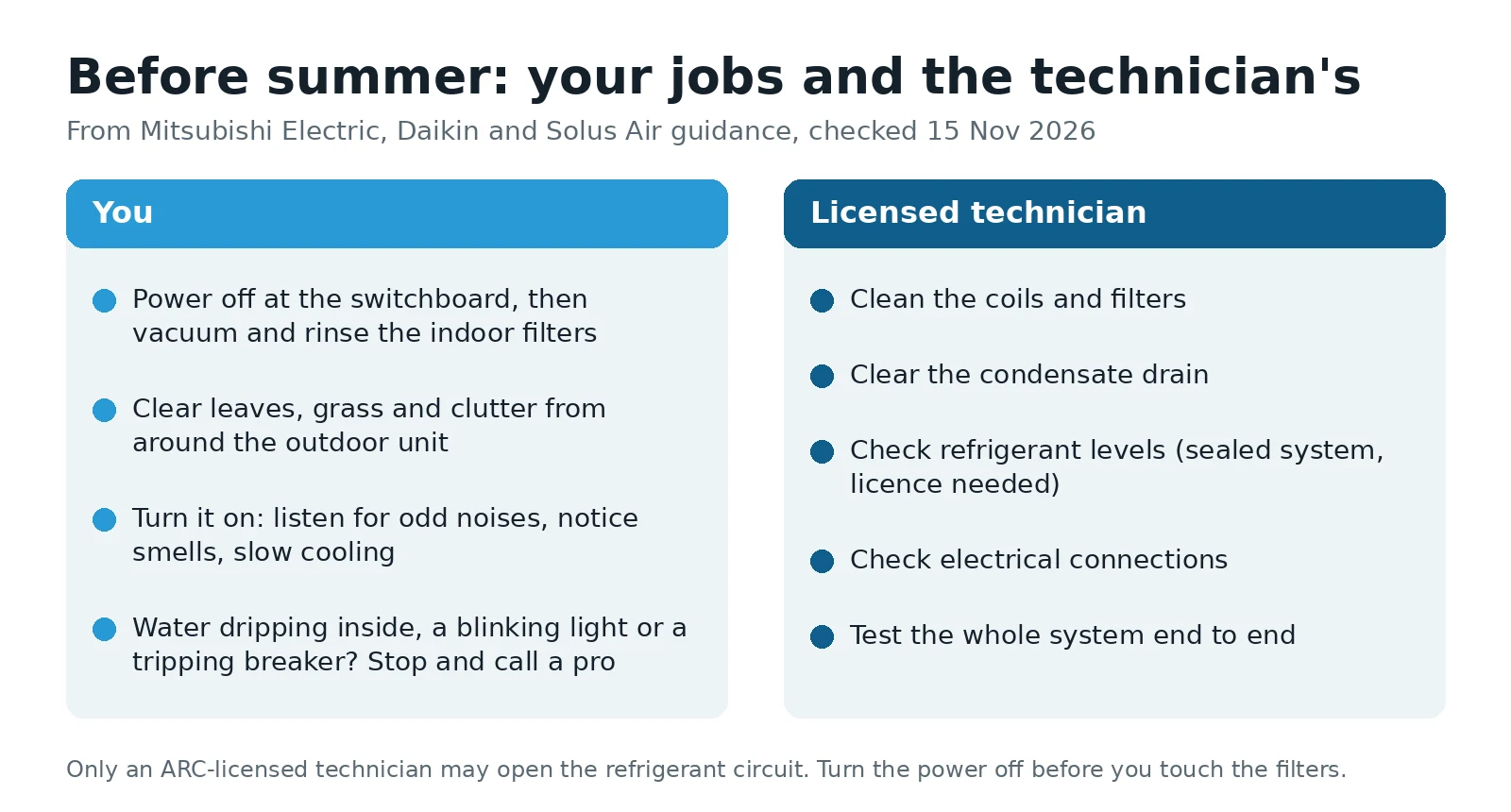
Filters are the owner’s job, and the most useful one. Daikin Australia says to clean the indoor filters every two weeks, more often in dusty homes, and that a clean filter can cut energy use by 5% to 15%. Mitsubishi Electric says every two weeks in peak season, every two to four weeks with regular use, and every three months for the secondary air-cleaning filter.
- Switch the system off, including at the switchboard, as Mitsubishi Electric advises.
- Open the front panel and unclip the filters. Your manual shows how for your model.
- Vacuum off loose dust with a soft brush attachment.
- Rinse in lukewarm water, with a little mild detergent if it’s greasy.
- Let them dry fully in the shade, then clip them back in.
- Outside, clear leaves and grass, trim back plants and move anything stacked against the unit.
- Turn it on and run it on cool. Listen for strange noises, notice any smells, and check it actually gets the room cool.
Warning signs to check before the heat arrives
Mitsubishi Electric suggests switching the system on every few months and looking for trouble on purpose, rather than waiting for a hot day to find it. Its list of signs is a good one for any brand:
- strange noises
- failing to reach the set temperature, or taking a long time to get there
- bad odours
- refrigerant leaks
- a thermostat reading that seems wrong
It also says to stop using the system and call your dealer if water leaks or drips from the indoor unit, the operation light blinks, the breaker trips often, or you hear an abnormal sound. Those are jobs for a technician, not for a cloth and a hose.
Ducted systems have a return air grille and filter, usually in a hallway ceiling. Check your manual for how to remove and clean it, and leave the ducts, fan coil and roof-space unit to the technician.
What a technician does in a service
A routine annual service usually covers cleaning the coils and filters, clearing the condensate drain, checking refrigerant levels and electrical connections, and testing the system end to end, according to Solus Air’s 2026 NSW price guide. Ask for a written list of what is included before you book, because “service” means different things to different businesses.
Who does the work matters. The NSW Government says you need a licence for air conditioning and refrigeration work to install, service or maintain any system other than a plug-in portable unit. Anyone handling refrigerant also needs an Australian Refrigeration Council licence. You can check a NSW licence on the NSW Government licence check in a minute.
What it costs in Sydney in 2026
| Job | Typical price (AUD) | Source |
|---|---|---|
| Split system service, single head | $120 to $280 | Solus Air, Back On Tools |
| Multi-head split, 3 or more heads | $280 to $450 | Back On Tools |
| Ducted system service | $180 to $550 | Solus Air, Back On Tools |
| Regas only, R32 or R410A | $200 to $350 | The Quote Yard |
| Find leak, repair and regas | $400 to $700 | The Quote Yard |
Back On Tools puts time on site at about 45 to 90 minutes for a single split and 2 to 3 hours for a split with three or more heads. These are published ranges, not quotes. Access (a two-storey wall, a tight roof space) and anything the technician finds will change the price. If a service turns up a fault, our repairs guide explains common problems and what they cost, and this guide to running costs shows what an inefficient system is costing you.
When to book
energy.gov.au suggests getting a service inspection before peak use, such as late spring. Mid-November is right on that line in Western Sydney. Technicians fill up quickly once the first hot week arrives, and a fault found now is cheaper than an emergency call-out in January.
A good booking includes: the model and age of your system, how many indoor units you have, any symptoms you’ve noticed, and where the outdoor unit sits. Then ask for a fixed price for the service, the technician’s licence numbers, and a short written report afterwards.
Get a service or quote from a licensed installer
We cover Western Sydney and the Hills, including Penrith, Blacktown and Castle Hill. Cozy Climates is a referral service. We pass your request to a licensed local business, which quotes and does the work. Read more on our air conditioning service page.
Book a pre-summer service
Tell us your suburb and your system. We pass your request to a licensed local technician, who contacts you to arrange a written price. It costs you nothing.
Common questions
How often should an air conditioner be serviced?
Once a year is the usual advice. Mitsubishi Electric recommends at least once a year, or twice a year if you use it heavily in summer and winter, and Daikin suggests a yearly check by a qualified technician before peak summer or winter.
When is the best time to service an aircon in Sydney?
Before you need it. energy.gov.au suggests a service inspection before peak use, such as late spring. In Western Sydney that means booking in November or early December, before the first run of hot days fills technicians’ diaries.
How much does an air conditioner service cost in Sydney?
About $120 to $280 for a single split system and about $180 to $550 for a ducted system, based on 2026 price guides from Solus Air and Back On Tools. Multi-head splits cost more, about $280 to $450 for three or more heads.
Can I service my own air conditioner?
You can clean the filters and keep the outdoor unit clear. Anything involving refrigerant or the inside of the unit needs a licensed technician. The NSW Government says you need a licence to service or maintain any system other than a plug-in portable unit.
Does skipping a service void my warranty?
Read your warranty card. Mitsubishi Electric’s warranty, for example, does not cover problems caused by dirty filters or blocked airflow, and says checking for obstructions is the owner’s responsibility. Your rights under the Australian Consumer Law still apply.
My aircon smells musty when I turn it on. Do I need a service?
Clean the filters first. If the smell stays, book a service. Mitsubishi Electric lists bad odours among the signs to look for before each season, and a technician can clean the coils and clear the drain.
General information only. Follow your manufacturer’s manual, switch the power off before cleaning, and leave refrigerant and electrical work to a licensed technician.
Sources
- energy.gov.au, Heating and cooling (servicing, bench testing)
- Daikin Australia, How often should I clean the filters?
- Mitsubishi Electric Australia, How to prepare your air conditioner for seasonal changes
- Mitsubishi Electric Australia, How to clean your air conditioner filter
- Mitsubishi Electric Australia, Air conditioning warranty card (PDF)
- NSW Government, Air conditioning and refrigeration work licences
- Australian Refrigeration Council, Licence types
- NSW Government licence check
- Solus Air, How much does air conditioner servicing cost in NSW in 2026?
- Back On Tools, Air conditioning service cost Sydney
- The Quote Yard, Air conditioning regassing cost NSW
- ACCC, Consumer rights and guarantees
- Bureau of Meteorology, Penrith Lakes climate averages
- Bureau of Meteorology, Sydney in January 2020