How much does air conditioning cost to run in Western Sydney?
Per-hour and per-summer running costs for split and ducted systems in Western Sydney, using 2026 Endeavour Energy rates and government energy-rating data.
Top photo: Pexels (photo 12243093, Robert So), Pexels licence
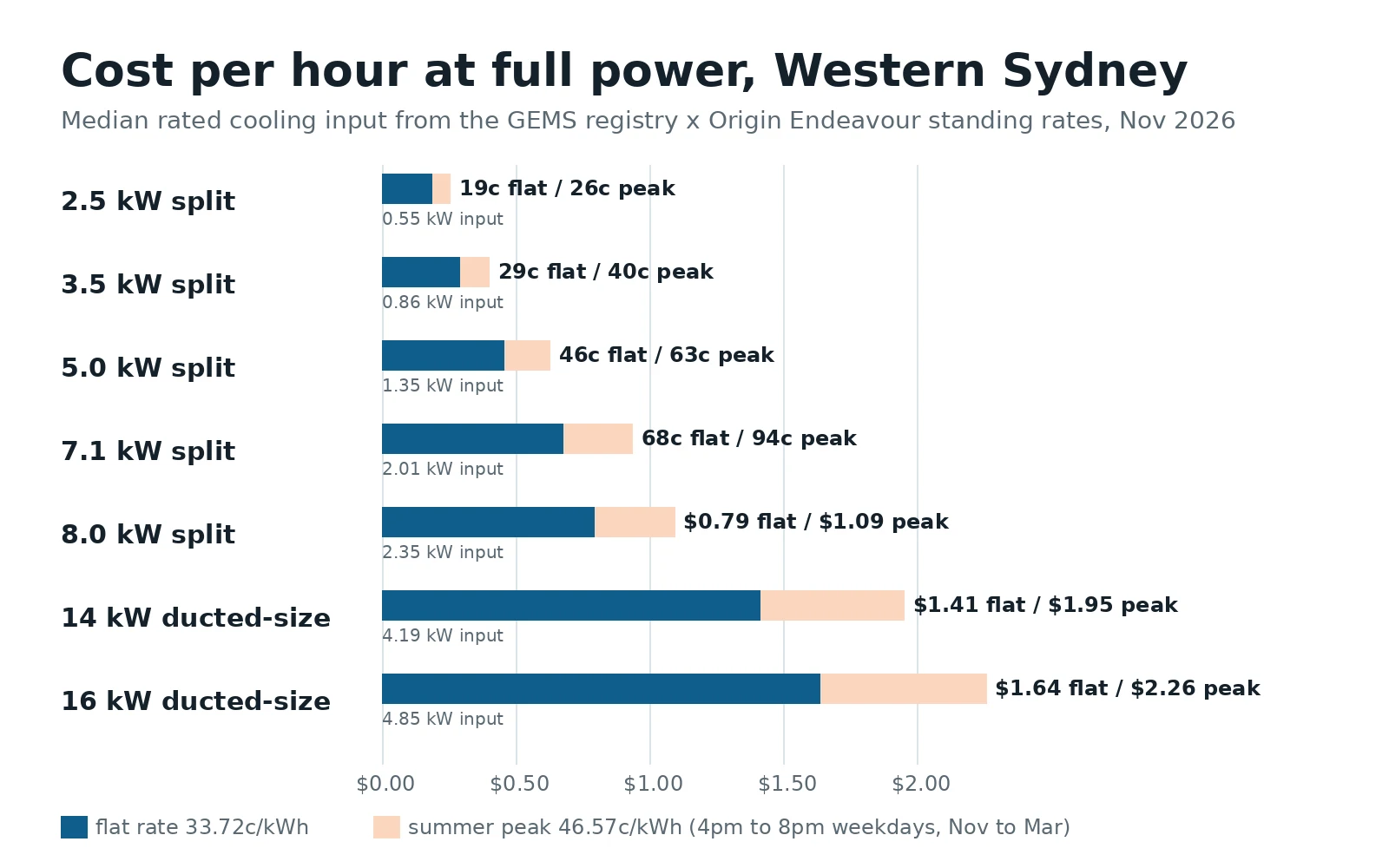
Quick answer: on the standard Endeavour Energy flat rate of about 33.7c per kWh, a small 2.5 kW split costs up to about 19c an hour, a 7.1 kW living-room split up to about 68c, and a 14 kW ducted system about $1.41 an hour at full power. Inverter systems usually run below full power once the house is cool, so most hours cost less.
By Johann. Last checked 15 November 2026. We calculated these figures from public data: the federal GEMS Registry of air conditioners and published 2026 retailer prices. We have not metered any homes, so treat them as a guide, not a measurement.
What a Western Sydney home pays per hour and per summer
Most of Western Sydney, from Penrith and Blacktown to Parramatta and the Hills, sits on the Endeavour Energy network, which covers Greater Western Sydney. From 1 July 2026, Origin Energy’s standing offer on that network charges 33.72c per kWh on a flat rate, plus a supply charge of $1.85 a day. The Sumo, Diamond Energy and WINconnect standing offers we checked for the same network are within a fraction of a cent of that, because the regulator caps standing offer prices.
For the power draw we used the GEMS Registry, the government list every air conditioner sold in Australia must be registered on. We took the median rated cooling power input for single-phase systems in each size (data file dated 15 November 2026). The last two columns use the cooling energy on the Zoned Energy Rating Label for the average climate zone, which assumes 840 hours of cooling a year from October to April.
| System size | Typical power input at full output | Per hour, flat rate | Per hour, summer peak (TOU) | Cooling energy a year (label, average zone) | Cooling cost a year, flat rate |
|---|---|---|---|---|---|
| 2.5 kW split (small bedroom) | 0.55 kW | 19c | 26c | 160 kWh | $54 |
| 3.5 kW split (bedroom or study) | 0.86 kW | 29c | 40c | 240 kWh | $81 |
| 5.0 kW split | 1.35 kW | 46c | 63c | 397 kWh | $134 |
| 7.1 kW split (living area) | 2.01 kW | 68c | 94c | 589 kWh | $199 |
| 8.0 kW split | 2.35 kW | 79c | $1.09 | 678 kWh | $229 |
| 14 kW ducted-size system | 4.19 kW | $1.41 | $1.95 | 1,308 kWh | $441 |
| 16 kW ducted-size system | 4.85 kW | $1.64 | $2.26 | 1,507 kWh | $508 |
Per hour figures use 33.72c per kWh (flat) and 46.57c per kWh (summer peak, 4pm to 8pm on working weekdays from November to March, Origin time-of-use). Ducted-size rows are 14 kW and 16 kW registered systems; real ducted systems also lose some energy through the ducts. Supply charges are not included because you pay them whether the aircon runs or not.
Why most hours cost less than the table
The per-hour column is the worst case: the compressor flat out. That happens when you first switch on in a hot house or on a 40°C afternoon. About 97% of the single split models on the GEMS Registry are variable speed (inverter) systems, which slow the compressor down once the room reaches your set temperature.
Here is a worked example, using our assumption rather than a measurement. Say a 7.1 kW split averages half its rated input over six hours on a hot evening. That is about 1 kW for 6 hours, or 6 kWh, which costs about $2.03 at 33.72c. Run it like that on 60 hot days and cooling adds roughly $120 to the summer bill. Your result could be well above or below that, depending on insulation, west-facing glass and the temperature you choose.
Western Sydney runs hotter than the label assumes for the coast
The label’s average zone uses weather data from Richmond, northwest of Sydney, according to Energy Rating. That makes it a reasonable fit for Western Sydney, much better than the coast. Even so, a hot year can push you past the 840 assumed hours. The Bureau of Meteorology puts the average January maximum at Penrith Lakes at 30.8°C, against 26.0°C at Sydney Observatory Hill, and Penrith Lakes reached 48.9°C on 4 January 2020.
So if you live out west and run the aircon most afternoons from December to February, budget towards the higher end. If you mostly use it on the worst days, the label figure is closer.
Flat rate or time of use: when you run it matters
If you have a smart meter you may be on a time-of-use plan. Origin’s Endeavour time-of-use standing offer from 1 July 2026 charges 46.57c per kWh in the summer peak (4pm to 8pm on working weekdays, November to March), 12.35c in the solar soak window (10am to 2pm every day) and 35.69c at other times. Check your bill for your own rates; Origin’s price sheet shows how the periods are defined.
That spread changes the best strategy. Cooling the house hard at 1pm costs about a quarter of the price of the same energy at 6pm. If you work from home, have solar panels, or can set a timer, pre-cool in the middle of the day, close the curtains, and let the aircon tick over gently through the peak.
Homes on the Ausgrid network (parts of Sydney closer to the city and the north) pay different rates. Origin’s Ausgrid standing offer is 33.14c per kWh flat, but its summer peak runs from 3pm to 9pm every day at 60.14c, so timing matters even more there.
For comparison, the Australian Energy Regulator’s 2026-27 reference bill for an Endeavour Energy home on a flat rate is $2,328 a year at 4,900 kWh. The regulator says that figure is a comparison price, not a prediction of your bill. Market offers can be cheaper, and Energy Made Easy lets you compare them.
Ducted vs split running costs
A ducted system cools the whole house from one big unit, so it usually draws more power than a single split. energy.gov.au says ducted systems are less efficient than wall units because they use a larger fan and lose energy through the ductwork. Zoning helps: if you only cool the living area and one bedroom, you are not paying to cool the spare rooms.
Splits are cheapest when you only need one or two rooms at a time. A whole-house ducted system makes sense if you cool most rooms on most days. Our guides to ducted air conditioning and split systems cover the install side.
Cheap ways to cut the cost this summer
- Go up a degree or two. energy.gov.au says each extra degree of cooling adds 5% to 10% to the energy used.
- Clean the filters. Daikin Australia says swapping a blocked filter for a clean one can cut energy use by 5% to 15%, and recommends cleaning them every two weeks.
- Use a fan with it. energy.gov.au says fans cost about 2c an hour to run and can make you feel about 3°C cooler, though they don’t cool the room itself.
- Close doors and curtains. Cooling only the rooms you use, and keeping the afternoon sun off the glass, means a smaller load on the system.
- Use the cheap hours. On a time-of-use plan, pre-cool between 10am and 2pm and coast through the peak.
- Get it serviced if it’s been a while. A government bench test reported by energy.gov.au found common faults, such as blocked coils and the wrong refrigerant charge, increased energy use by 14% to 20% on average. See our air conditioning service page and whether to service before summer.
When a newer system pays off
If your system is old, check its star rating against a new one on the Zoned Energy Rating Label. More stars for the same size means lower running costs. The NSW Government’s air conditioner upgrade incentive offers an upfront discount through participating installers, with indicative amounts of up to $550 for a new 6 kW system and up to $560 when replacing an old one with a 6 kW split. Paperwork has to be done before installation, and amounts vary, so ask each installer to show it on the quote. Our replacement guide covers when it’s worth switching.
How to work out your own running cost
- Find your usage rate on your latest bill. It is shown in cents per kWh; on a time-of-use plan there will be several.
- Find your system’s model number on the indoor or outdoor unit, then look it up on the Energy Rating Calculator or the GEMS Registry.
- For a yearly estimate, multiply the cooling kWh on the label (average zone for Western Sydney) by your rate in dollars. For example, 589 kWh x $0.3372 = about $199.
- For one hour at full power, multiply the rated cooling power input in kW by your rate. For example, 2.01 kW x $0.3372 = about 68c.
The Energy Rating Calculator can also compare two models side by side over ten years, which is handy when you’re choosing between quotes.
Need a quote for a more efficient system?
We cover homes across Western Sydney and the Hills, including Penrith, Blacktown and Castle Hill. Cozy Climates is a referral service, not an installer. We pass your request to a licensed local installer, who quotes and does the work.
Get a quote from a licensed installer
Tell us your suburb and what you need. We pass your request to a licensed local installer, who contacts you to arrange a written quote. It costs you nothing.
Common questions
How much does it cost to run a split system per hour in Western Sydney?
At full power, a typical 2.5 kW split costs about 19c an hour and a 7.1 kW split about 68c an hour on a flat rate of 33.72c per kWh (Origin Energy standing offer, Endeavour Energy network, from 1 July 2026). Inverter systems usually run below full power once the room is cool, so most hours cost less.
Is it cheaper to leave the air conditioner on all day?
Not as a rule. energy.gov.au says you save by switching it off when you leave the house or go to bed. Mitsubishi Electric suggests cooling gradually rather than blasting a hot house at the lowest setting. On a time-of-use plan, running it in the cheap solar-soak window (10am to 2pm) and coasting through the 4pm to 8pm peak can help.
What temperature should I set my aircon to in summer?
energy.gov.au says each extra degree of cooling adds 5% to 10% to the energy used. Mitsubishi Electric recommends 22°C to 23°C for its systems. Pick the warmest setting you are comfortable at and use a fan as well.
Is ducted air conditioning more expensive to run than a split system?
Usually, yes. energy.gov.au says ducted systems are less efficient than wall units because they use a larger fan and lose energy through the ductwork. Zoning, so you only cool the rooms in use, narrows the gap.
Does a dirty filter really make a difference?
Yes. Daikin Australia says replacing a blocked filter with a clean one can cut energy use by 5% to 15%. A government bench test found common faults such as blocked coils or the wrong refrigerant charge raised energy use by 14% to 20% on average.
How do I work out my own running cost?
Find the cooling kWh figure on the Zoned Energy Rating Label (use the average zone for Western Sydney) and multiply it by your usage rate in dollars per kWh from your bill. For one hour, multiply the rated power input in kW by your rate.
General information only. Electricity prices change, and your own plan, home and habits decide what you pay. Check your latest bill and get advice from a licensed installer for your home.
Sources
- Origin Energy, Endeavour Distribution Zone standing offer prices, effective 1 July 2026 (PDF)
- Origin Energy, Ausgrid Distribution Zone standing offer prices, effective 1 July 2026 (PDF)
- Australian Energy Regulator, Default Market Offer 2026-27
- Endeavour Energy, Who we are (network area)
- data.gov.au, Energy Rating for household appliances: air conditioner registry file, 15 Nov 2026
- Energy Rating, Understand the Zoned Energy Rating Label
- energy.gov.au, Heating and cooling
- Daikin Australia, How often should I clean the filters?
- Bureau of Meteorology, Penrith Lakes AWS climate averages
- Bureau of Meteorology, Sydney Observatory Hill climate averages
- Bureau of Meteorology, Sydney in January 2020
- NSW Government, Air conditioner upgrade incentive