Air conditioning running costs in Australia: the numbers
Electricity prices, heat days and efficiency figures behind what air conditioning costs to run in Western Sydney, each linked to its source.
Top photo: Fatih Turan / Pexels (Pexels licence)
Quick answer: in Western Sydney, the regulated price cap for electricity is 33.73c per kWh on a flat rate from 1 July 2026, and 12.35c in the 10am to 2pm window on time-of-use plans (AER). Heating and cooling can use 20% to 50% of a home’s energy (energy.gov.au), and Penrith averages 21.9 days a year at 35°C or more (BOM).
By Johann. Last checked 19 November 2026. This page collects published figures from the Australian Energy Regulator (AER), energy.gov.au, the Bureau of Meteorology (BOM) and the Australian Bureau of Statistics (ABS). We haven’t metered any homes. Where we did our own sums, we say so.
Want a cost per hour for your own system size? Our Western Sydney running cost guide works it out for split and ducted systems. This page is the reference sheet behind it.
The key numbers at a glance
| Statistic | Figure | Source |
|---|---|---|
| Flat-rate price cap, Endeavour Energy network (Western Sydney), 2026-27 | 33.73c per kWh | AER Default Market Offer |
| Daily supply charge cap, Endeavour Energy | $1.85 a day | AER Default Market Offer |
| Cheapest time-of-use window, Endeavour Energy | 12.35c per kWh, 10am to 2pm | AER Default Market Offer |
| Peak time-of-use rate, Endeavour Energy | 46.57c or 47.14c per kWh, 4pm to 8pm | AER Default Market Offer |
| Annual reference bill, Endeavour, flat rate | $2,328 at 4,900 kWh a year | AER information kit, May 2026 |
| Share of home energy used for heating and cooling | 20% to 50% | energy.gov.au |
| Extra energy for each degree cooler you set it | 5% to 10% | energy.gov.au |
| Days a year at 35°C or more, Penrith Lakes | 21.9 | Bureau of Meteorology |
| Households using reverse cycle as main cooling (Australia, 2014) | 49% | ABS |
What does electricity cost in Western Sydney in 2026?
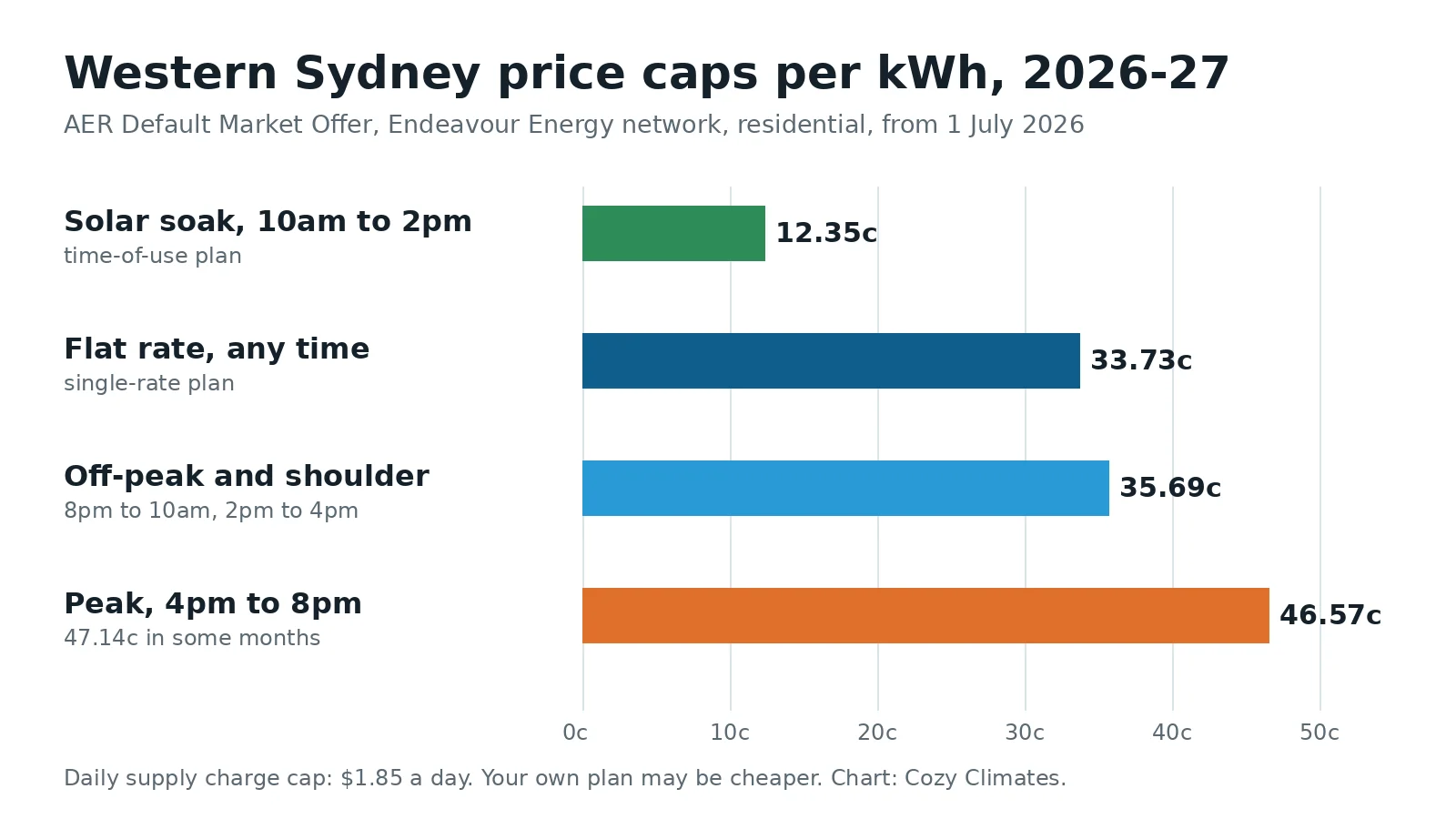
Most of Western Sydney is on the Endeavour Energy network, which connects 2.8 million people across Greater Western Sydney, the Blue Mountains, the Illawarra and parts of regional NSW. Each year the AER sets a Default Market Offer (DMO). It’s the most a retailer can charge on a standing offer, and the price caps apply from 1 July 2026 to 30 June 2027.
| Endeavour Energy plan type (residential) | Time | Price cap |
|---|---|---|
| Flat rate | Any time | 33.73c per kWh |
| Time of use | 10am to 2pm | 12.35c per kWh |
| Time of use | 2pm to 4pm, and 8pm to 10am | 35.69c per kWh |
| Time of use | 4pm to 8pm | 46.57c or 47.14c per kWh (varies through the year) |
| Solar Saver offer | 11am to 2pm | Free |
| Solar Saver offer | 10am to 11am | 14.19c per kWh |
| All plan types | Daily supply charge | $1.85 a day |
Source: AER, Default Market Offer 2026-27, Endeavour Energy tariff caps, checked 19 November 2026. The AER says some charges vary across the year in line with local network tariffs.
Many other Sydney homes are on the Ausgrid network instead. Its caps are 33.14c per kWh flat with a $1.66 daily supply charge, or 24.04c off-peak and 60.20c from 3pm to 9pm on time of use. That longer, pricier peak makes timing matter even more there.
What will a year of electricity cost?
The AER also publishes a reference annual bill for a typical home in each area. It’s a comparison figure, not a prediction of your bill. From its May 2026 information kit:
| Network (residential) | Usage assumed | 2026-27 flat rate | 2026-27 time of use | Change on 2025-26 (flat) |
|---|---|---|---|---|
| Endeavour (Western Sydney) | 4,900 kWh | $2,328 | $2,320 | down $83 (3.4%) |
| Ausgrid (Sydney) | 3,900 kWh | $1,899 | $1,893 | down $66 (3.4%) |
| Essential Energy (regional NSW) | 4,600 kWh | $2,604 | $2,530 | down $137 (5.0%) |
Notice that Endeavour’s reference home uses 1,000 kWh a year more than Ausgrid’s. The AER sets each figure from typical usage in that network area, so the annual bills aren’t a like-for-like price comparison. The per-kWh caps are.
You don’t have to pay the DMO. Market offers are often cheaper, and the government’s Energy Made Easy site compares them by postcode.
How much energy does air conditioning use in a home?
According to energy.gov.au, the federal energy advice site:
- Heating and cooling can account for 20% to 50% of the energy used in Australian homes, depending on the climate zone.
- Each extra degree of cooling in summer, or heating in winter, adds 5% to 10% to the energy used.
- Reverse cycle air conditioners on the Australian market are 300% to 600% efficient, because they move heat rather than make it. A plain electric heater is 100% efficient.
- A fan blowing on you can make it feel about 3°C cooler.
- In a government test, common faults such as dirty coils or the wrong refrigerant charge raised energy use by 14% to 20% on average.
That last point is one reason Daikin and Mitsubishi Electric both recommend a yearly service. Our pre-summer service guide lists what you can clean yourself and what needs a licensed technician.
How hot does Western Sydney get compared with the city?
Bureau of Meteorology climate averages show how different summer is out west. Penrith Lakes records cover 1995 to 2026; Observatory Hill records run from 1859 to 2020, so the periods aren’t the same, but the gap is large either way.
| BOM climate average | Penrith Lakes AWS | Sydney (Observatory Hill) |
|---|---|---|
| Days a year at 35°C or more | 21.9 | 3.2 |
| Days a year at 40°C or more | 4.7 | 0.3 |
| Days a year at 30°C or more | 71.5 | 15.2 |
| Mean January maximum | 30.8°C | 26.0°C |
| Highest temperature on record | 48.9°C (4 January 2020) | 45.8°C (18 January 2013) |
Sources: BOM, Penrith Lakes AWS climate statistics and BOM, Sydney Observatory Hill climate statistics, checked 19 November 2026.
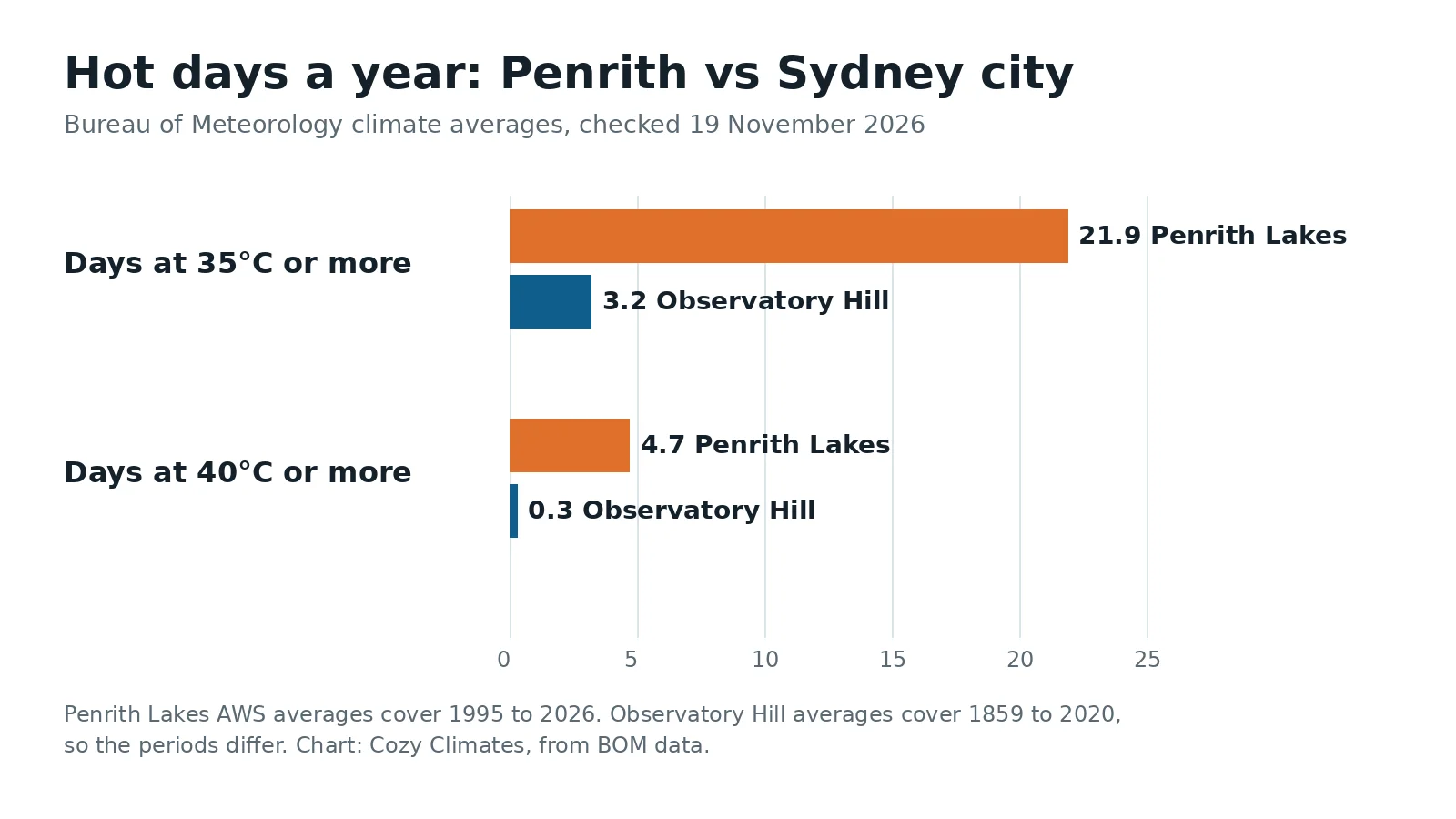
More hot days means more hours with the compressor working hard. If you live in Penrith, Blacktown or the Hills, tell your installer the system needs to cope with the hot end of the range. Our pages for Penrith, Blacktown and Castle Hill cover what local installers look at.
How many Australian homes have air conditioning?
The ABS last asked about this in its Environmental Issues: Energy Use and Conservation survey, March 2014. It’s old, and ownership has almost certainly changed since, but it’s still the most recent official count:
- About three quarters of Australian households used some form of cooling.
- 49% used reverse cycle air conditioning as their main cooling system.
- 13% mainly used evaporative coolers and 10% used refrigerated, cooling-only air conditioning.
- 26% didn’t use any air conditioning for cooling, ranging from 48% in Tasmania to 4% in the Northern Territory.
Reverse cycle was already the most common choice in 2014, and it heats as well as cools. If you’re weighing one up, see reverse cycle heating or compare split systems with ducted air conditioning.
What our own sums show
These are our calculations from the AER caps above, not published figures. A system drawing 1 kW of electricity for one hour uses 1 kWh, so on the Endeavour caps:
| When it runs | Cost of 1 kWh (our calculation) |
|---|---|
| 10am to 2pm, time of use | about 12c |
| Any time, flat rate | about 34c |
| 4pm to 8pm, time of use | about 47c |
Cooling the same house at 1pm instead of 6pm costs roughly a quarter as much per kWh on a time-of-use plan. If you’re home in the middle of the day or have solar, pre-cooling before 2pm and closing the curtains is the cheapest way through a hot evening. Supply charges aren’t included, because you pay them whether the aircon runs or not.
How to check if you’re paying too much
Grab your latest bill and compare your usage rate and supply charge with the caps above. If you’re on a standing offer, a market offer may be cheaper. This short video shows how the comparison site works.
Get a quote from a licensed installer
Tell us your suburb and what you need. We pass your request to a licensed local installer, who contacts you to arrange a written quote. It costs you nothing.
Common questions
How much does electricity cost in Western Sydney in 2026?
The AER caps the standing offer on the Endeavour Energy network at 33.73c per kWh on a flat rate, plus a daily supply charge of up to $1.85, from 1 July 2026 to 30 June 2027. Market offers can be cheaper.
What is the cheapest time to run air conditioning in Western Sydney?
On an Endeavour Energy time-of-use plan capped by the AER, 10am to 2pm is cheapest at 12.35c per kWh. The dearest time is 4pm to 8pm, at 46.57c or 47.14c depending on the month.
How much of a household energy bill goes on heating and cooling?
energy.gov.au says heating and cooling can account for 20% to 50% of the energy used in Australian homes, depending on the climate zone.
How much does turning the thermostat up one degree save?
energy.gov.au says each extra degree of cooling in summer, or heating in winter, increases energy use by 5% to 10%.
How many hot days does Penrith get?
The Bureau of Meteorology averages 21.9 days a year at 35°C or more at Penrith Lakes, based on records from 1995 to 2026. Sydney Observatory Hill averages 3.2.
How many Australian homes have air conditioning?
The last ABS survey on this, from March 2014, found about three quarters of Australian households used some form of cooling, and 49% used reverse cycle air conditioning as their main system.
Sources
- AER: The Default Market Offer (2026-27 price caps)
- AER: Information Kit, Default Market Offer 2026-27 (May 2026, PDF)
- energy.gov.au: Heating and cooling
- Bureau of Meteorology: Penrith Lakes AWS climate statistics
- Bureau of Meteorology: Sydney (Observatory Hill) climate statistics
- ABS: Environmental Issues: Energy Use and Conservation, Mar 2014
- Endeavour Energy: Who we are
- Energy Made Easy (AER plan comparison)
General information only. Electricity prices change, and your own plan, home and habits decide what you pay. Check your latest bill and get advice from a licensed installer for your home.